UHST is a strong advocate of fostering a reading culture in schools. We are delighted that the Humanist schools share this passion. Schools do their best to help children to become proficient in the use of books and on-line information. They welcome help in acquiring up-to-date material to reinforce and supplement what their children learn from teachers. Competency in reading equips children to evaluate arguments and evidence and to become free and critical thinkers.
Ensuring that Humanist schools have a plentiful supply of books and other reading sources is essential, though not sufficient. Teachers accept that their job goes beyond conveying information by telling and writing on chalk boards. They try to enable children to become independent learners and experience the joy of discovery. The central investigative skill is reading, and teachers try to foster it both in and out of lessons.
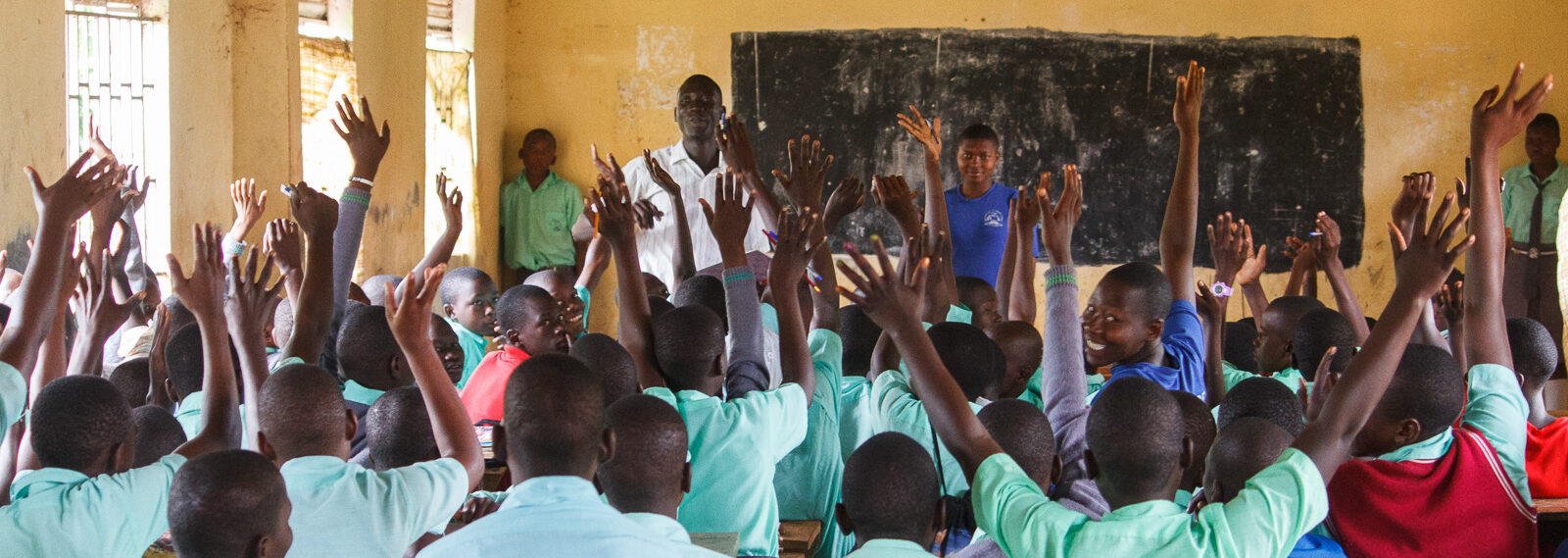
Young readers at Eagle’s View Primary School
Kasese library being tiled & refurbished
Learning to read well in primary school gives children an advantage through the rest of their lives. Primary teachers in the Humanist skills have wonderful didactive skills. They are expert in developing reading competency with little more than a piece of chalk, a wall chart and repetitive verbal drills. “A cow is an animal. A tree is a plant. What is a cow? A cow is an animal. What is a tree? A tree is a plant? How do we spell animal? We spell animal a-n-i-m-a-l. How do we spell animal? And so on. Every child is engaged by this approach. No child is left behind. Children thoroughly enjoy this very skilled oral transmission of information and it has proved to be effective. Books do, however, considerably speed up vocabulary acquisition. This is why we are trying to equip the Humanist primary schools with well designed graded reading schemes, with easy reading books, non-fiction as well as fiction, and with learners’ dictionaries to enable children to look up unfamiliar words.
Textbooks are used to support learning both within lessons and for preparatory and follow-up reading out of lessons. For this to happen there must be sufficient copies of a textbook to ensure that there are no more than 3 children per book. A decent subject textbook eases the burden on the teacher and empowers children. Textbooks free teachers from mindless dictation and endless writing of notes on the chalk board. They allow students to read in preparation for a lesson, to make notes after the lesson on points they missed or misunderstood and to see the correct spelling of words. Online resources such as Wikipedia and RACHEL, and attractive reference books in a well-stocked library also provide valuable reading and learning opportunities outside lessons.
Reading for Pleasure Competitions, which stopped during Covid, are restarting this year. Students enter the competition by borrowing and reading 5 books from the library. They write a brief review of a chosen book and say why they would encourage others to read it. A short list of finalists is drawn up and each presents a review in front of other students. Winners receive prizes of a dictionary and money to spend as they wish. The competitions are very popular. A current new English teacher at Mustard Seed school explained that winning the competition inspired him to go to university and return to his school as a teacher. Girl in Reading for Pleasure Competition at Isaac Newton..
UHST supports 11 schools with over 4,000 students. Our aim is to raise enough money each year to be able to flood each school with books. We want to help the schools to foster a reading culture. This will enable students of Humanist schools to become independent enquirers who are motivated to understand the world and to identify and resist mis-information and indoctrination.
At the start of each school year, girls in the Humanist schools supported by UHST receive packs of Afripads. These are neatly designed reusable sanitary pads which are supplied each year with funds generously donated by members of the Ethical Society of St. Louis in the United States.
Afripads Schoolgirl Kit
Each pack is washable and lasts for over 60 washes and more than 12 months. The pads have an all-in-one design with wings and buttons for simple fastening. They have an advanced stay-dry top layer, ultra-absorbent core layers and an anti-leak security layer. They come with a menstrual training pack to help the school nurse when instructing girls in their use and a Girl Talk Booklet for primary and pre-menstruating girls.
In 2024 we were able to supply Afripads to girls at Isaac Newton, Mustard Seed and Kasese High schools, and to primary school girls who need them at Katumba, Kanungu, Eagle’s View, Isaac Newton and Mustard Seed.
Kanungu: “Our school senior woman Teacher Evelyn explained to girls how to use the pads using the manual the Afripads company sent. We distribute padsto girls above 10 years. They were very excited and appreciative of this great support, the support which many other schools can’t manage!”
Kasese: “Afripads were requested by our female teachers, who were so grateful to St Louis and UHST for making this possible.”
The senior woman teacher at Kasese, Betty Biira, explains that while the pads are welcomed by all girls and senior teachers, some girls in their homes lack soap, clean water and buckets to keep the pads really clean. We are looking into ways that schools might be able to help those girls who have this problem.
Afripads have enabled girls to feel comfortable and to be more confident in school during their periods. Since we started to provide Afripads girls’ absence from school and from lessons has fallen dramatically. These days girls and boys attendance are similar and attainment levels of girls match those of boys. Members of the Ethical Society of St Louis should feel justly proud of this valuable contribution that they make to girls’ education in the Humanist schools each year.
Uganda Advanced Certificate of Education (A-level) is the gateway to further and higher education. This year every Humanist school student in Uganda who entered for the exam achieved the minimum of two principal passes required by universities. However, only the following three top-performing students gained the cherished 15 points required for a government scholarship:
Mike Crispus Lwasampijja: Mathematics A, Physics A, Chemistry B (Isaac Newton)
Bruno Muwulya: Mathematics A, Chemistry B, Biology C (Isaac Newton)
Christopher Kikomaga: Entrepreneurship A, Geography B, Mathematics C (Mustard Seed)
Scholarships cover university fees, but students are expected to cover subsistence and lodging from their own resources. Many other students will receive offers of places on university degree and diploma courses, but few will be able to cover the cost of fees, accommodation, subsistence and other incidentals, which can, depending on the course, amount to hundreds or even a few thousand pounds each year. Fortunately for those students who choose to train as teachers or for nursing and ancillary health jobs, there are government grants, which cover most of the costs. Students with lower grades and even a single A-level will find there are many jobs that allow part-time study to gain vocational qualifications. A few very able students are offered teaching posts at the Humanist Schools. This enables them to pay their way through degree courses while the school benefits from their knowledge and commitment as novice teachers.
A-level Chemistry class at Isaac Newton High School
The schools would like to expand their A-level sections. Staff like to have the challenge of A-level teaching and schools want to offer their bright students from UCE O-level the opportunity to progress. However, in the absence of scholarships for A-level study, only students whose families can raise money for fees can continue. High performing scholarship students from poor homes have no alternative but to drop out of education after O-level.
Humanist Schools want to prioritise the provision of Senior 1 scholarships for children who have done well in the Primary Leaving Examination. For this reason, it has been the practice for UHST supporters to be asked to support a new Senior 1 student once their current child has reached O-level.
It is a dilemma. Should new scholarships be reserved for:
Children who have done well in the Primary Leaving Examination and who wish to move on to secondary educations, or
Children who have done well at O-level in Senior 4 and who wish to progress to A-level courses, the gateway to further and higher education courses if they can secure the funding required.
There is a further consideration. If we routinely use UHST scholarships to cover 6 years of secondary schooling instead of 4 then one-third fewer students will receive scholarships.
On the other hand, supporting high achieving students from poor homes to take A-level would not only help those individuals it would also raise the overall performance of all A-level students.
The schools are wondering if they could draw money from overall fee income to offer reduced A-level fees to these deserving students. UHST wishes to help by attracting more money for scholarships. If you would like to help, then please visit our donate page.
UGANDA ADVANCED CERTIFICATE IN EDUCATION 2023 A-LEVEL EXAMINATION RESULTS, published March 2024

Posted: April 18, 2024 by Steve Hurd
Fostering a Reading Culture
UHST is a strong advocate of fostering a reading culture in schools. We are delighted that the Humanist schools share this passion. Schools do their best to help children to become proficient in the use of books and on-line information. They welcome help in acquiring up-to-date material to reinforce and supplement what their children learn from teachers. Competency in reading equips children to evaluate arguments and evidence and to become free and critical thinkers.
Ensuring that Humanist schools have a plentiful supply of books and other reading sources is essential, though not sufficient. Teachers accept that their job goes beyond conveying information by telling and writing on chalk boards. They try to enable children to become independent learners and experience the joy of discovery. The central investigative skill is reading, and teachers try to foster it both in and out of lessons.
Learning to read well in primary school gives children an advantage through the rest of their lives. Primary teachers in the Humanist skills have wonderful didactive skills. They are expert in developing reading competency with little more than a piece of chalk, a wall chart and repetitive verbal drills. “A cow is an animal. A tree is a plant. What is a cow? A cow is an animal. What is a tree? A tree is a plant? How do we spell animal? We spell animal a-n-i-m-a-l. How do we spell animal? And so on. Every child is engaged by this approach. No child is left behind. Children thoroughly enjoy this very skilled oral transmission of information and it has proved to be effective. Books do, however, considerably speed up vocabulary acquisition. This is why we are trying to equip the Humanist primary schools with well designed graded reading schemes, with easy reading books, non-fiction as well as fiction, and with learners’ dictionaries to enable children to look up unfamiliar words.
Textbooks are used to support learning both within lessons and for preparatory and follow-up reading out of lessons. For this to happen there must be sufficient copies of a textbook to ensure that there are no more than 3 children per book. A decent subject textbook eases the burden on the teacher and empowers children. Textbooks free teachers from mindless dictation and endless writing of notes on the chalk board. They allow students to read in preparation for a lesson, to make notes after the lesson on points they missed or misunderstood and to see the correct spelling of words. Online resources such as Wikipedia and RACHEL, and attractive reference books in a well-stocked library also provide valuable reading and learning opportunities outside lessons.
Reading for Pleasure Competitions, which stopped during Covid, are restarting this year. Students enter the competition by borrowing and reading 5 books from the library. They write a brief review of a chosen book and say why they would encourage others to read it. A short list of finalists is drawn up and each presents a review in front of other students. Winners receive prizes of a dictionary and money to spend as they wish. The competitions are very popular. A current new English teacher at Mustard Seed school explained that winning the competition inspired him to go to university and return to his school as a teacher.
Girl in Reading for Pleasure Competition at Isaac Newton..
UHST supports 11 schools with over 4,000 students. Our aim is to raise enough money each year to be able to flood each school with books. We want to help the schools to foster a reading culture. This will enable students of Humanist schools to become independent enquirers who are motivated to understand the world and to identify and resist mis-information and indoctrination.
Posted: April 17, 2024 by Steve Hurd
Girls love their Afripads
At the start of each school year, girls in the Humanist schools supported by UHST receive packs of Afripads. These are neatly designed reusable sanitary pads which are supplied each year with funds generously donated by members of the Ethical Society of St. Louis in the United States.
Each pack is washable and lasts for over 60 washes and more than 12 months. The pads have an all-in-one design with wings and buttons for simple fastening. They have an advanced stay-dry top layer, ultra-absorbent core layers and an anti-leak security layer. They come with a menstrual training pack to help the school nurse when instructing girls in their use and a Girl Talk Booklet for primary and pre-menstruating girls.
In 2024 we were able to supply Afripads to girls at Isaac Newton, Mustard Seed and Kasese High schools, and to primary school girls who need them at Katumba, Kanungu, Eagle’s View, Isaac Newton and Mustard Seed.
Kanungu: “Our school senior woman Teacher Evelyn explained to girls how to use the pads using the manual the Afripads company sent. We distribute pads to girls above 10 years. They were very excited and appreciative of this great support, the support which many other schools can’t manage!”
Kasese: “Afripads were requested by our female teachers, who were so grateful to St Louis and UHST for making this possible.”
Letter of appreciation by the Head Girl of Kasese Rukoki Primary School.
The senior woman teacher at Kasese, Betty Biira, explains that while the pads are welcomed by all girls and senior teachers, some girls in their homes lack soap, clean water and buckets to keep the pads really clean. We are looking into ways that schools might be able to help those girls who have this problem.
Afripads have enabled girls to feel comfortable and to be more confident in school during their periods. Since we started to provide Afripads girls’ absence from school and from lessons has fallen dramatically. These days girls and boys attendance are similar and attainment levels of girls match those of boys. Members of the Ethical Society of St Louis should feel justly proud of this valuable contribution that they make to girls’ education in the Humanist schools each year.
Posted: March 29, 2024 by Steve Hurd
A-level scholarships dilemma
Uganda Advanced Certificate of Education (A-level) is the gateway to further and higher education. This year every Humanist school student in Uganda who entered for the exam achieved the minimum of two principal passes required by universities. However, only the following three top-performing students gained the cherished 15 points required for a government scholarship:
Mike Crispus Lwasampijja: Mathematics A, Physics A, Chemistry B (Isaac Newton)
Bruno Muwulya: Mathematics A, Chemistry B, Biology C (Isaac Newton)
Christopher Kikomaga: Entrepreneurship A, Geography B, Mathematics C (Mustard Seed)
Scholarships cover university fees, but students are expected to cover subsistence and lodging from their own resources. Many other students will receive offers of places on university degree and diploma courses, but few will be able to cover the cost of fees, accommodation, subsistence and other incidentals, which can, depending on the course, amount to hundreds or even a few thousand pounds each year. Fortunately for those students who choose to train as teachers or for nursing and ancillary health jobs, there are government grants, which cover most of the costs. Students with lower grades and even a single A-level will find there are many jobs that allow part-time study to gain vocational qualifications. A few very able students are offered teaching posts at the Humanist Schools. This enables them to pay their way through degree courses while the school benefits from their knowledge and commitment as novice teachers.
The schools would like to expand their A-level sections. Staff like to have the challenge of A-level teaching and schools want to offer their bright students from UCE O-level the opportunity to progress. However, in the absence of scholarships for A-level study, only students whose families can raise money for fees can continue. High performing scholarship students from poor homes have no alternative but to drop out of education after O-level.
Humanist Schools want to prioritise the provision of Senior 1 scholarships for children who have done well in the Primary Leaving Examination. For this reason, it has been the practice for UHST supporters to be asked to support a new Senior 1 student once their current child has reached O-level.
It is a dilemma. Should new scholarships be reserved for:
There is a further consideration. If we routinely use UHST scholarships to cover 6 years of secondary schooling instead of 4 then one-third fewer students will receive scholarships.
On the other hand, supporting high achieving students from poor homes to take A-level would not only help those individuals it would also raise the overall performance of all A-level students.
The schools are wondering if they could draw money from overall fee income to offer reduced A-level fees to these deserving students. UHST wishes to help by attracting more money for scholarships. If you would like to help, then please visit our donate page.
UGANDA ADVANCED CERTIFICATE IN EDUCATION
2023 A-LEVEL EXAMINATION RESULTS, published March 2024
= or better than
minimum
university
requirement