 Isaac Newton High School, Masaka has just chalked up the best A-level Exam results in its short history. Of 25 students entered for the examinations, 9 gained passes in 3 A-level subjects, 7 passed 2 subjects and 9 students passed in one subject. The table below shows the distribution of grades awarded, which is remarkable for a rural school and surpasses those of other schools in their District.
Top performing A-level student in 2013: Rebecca Nakayiwa (right)
At Isaac Newton School, several students met the minimum requirements for a government scholarship to study for a university degree. Scholarships are highly prized. They cover university fees and contribute towards a student’s living costs. Unfortunately, in practice, scholarships are thin on the ground and are more likely to be awarded for science courses than for arts ones. In Uganda a certain number, limited by national funds available, are awarded each year on a mandatory basis to the very best performing students. To ensure fairness between parts of the country, others are awarded on a regional quota basis. All scholarships are awarded strictly on merit. Unfortunately, there has been less money available at national level in 2014 as a number of countries, e.g. those in Scandinavia, have suspended official aid to Uganda due to concern over the illiberal homosexuality bill that has been working its way into law.
|
2013 A-Level Uganda Advanced Certificate Results |
|
| Grades |
A
|
B
|
C
|
D
|
E
|
O
|
F
|
| Isaac Newton |
1
|
8
|
11
|
17
|
11
|
20
|
4
|
* A-level points: The grades for A-levels and subsidiary subjects are aggregated into an overall points score (A=6, B=5, C=4 and so on). The points aggregate determines entry to more advanced study. Any double-digit aggregate (the equivalent of two grade Bs or better) could secure a place in a good university.
At Isaac Newton High School the two top performing students were:
Rebecca Nakayiwa (above right) gained 15 points from an A, B and D in Arts subjects with a 4 in subsidiary Mathematics. Her best subject was Luganda. Rebecca was funded up to O-level by a scholarship provided by a UHST supporter. As an Arts student, Rebecca is still waiting to hear whether she will be awarded a regional quota scholarship to attend university.
James Kemigisha (below right) gained 14 points from a B, B and D with a 5 in subsidiary Mathematics. His best subjects were Economics and Agriculture. James has already been awarded a mandatory scholarship to study for a degree in Agricultural Development, Rural Transformation and Innovation at Kyambogo University.
At least 10 students have gained grades that would get them onto a university course. However, most will only be able to go if they can find the fees required. Since education was liberalised in Uganda many new universities have been established. The lower tier institutions charge £100 per term for Diploma courses and £200 for degree courses. However, the more highly rated universities and courses charge considerably more than this. Such fees are generally prohibitive for students from a rural background.
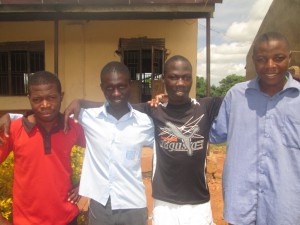 Successful students: Lukenge Alexander, Kasasa Peter, Ssenkabirwa Nicholous, Kamugisha James (all with temporary teaching posts at the Mbute Campus of Isaac Newton)
In order to help students to save some money towards their university expenses Peter Kisirinya gives his best performing students temporary teaching posts at Mbute and Kateera to bridge the time, almost a year, between sitting A-levels and taking up a university place. He even has a few students who travel back to the schools to do some teaching one or two days a week once they are at university. This helps them to pay their way through their courses and, at the same time, benefits greatly the school students by boosting the number of teachers in school, while keeping down staffing costs.
Only a small number of students from the 2013 cohort will go on to full-time university degree courses. However, almost all of the rest will take Diploma courses and higher level vocational training. The opportunities the schools have given them will transform the life chances of all of these young people. While most will leave their village, strong family bonds in Uganda will see them returning home often and bringing money to boost the incomes of family members in the local community. In line with the report I wrote in November 2013 on the economic impact of the schools on their local community, the income which these young people bring back to their community will help to transform the standard of living of people in their home areas.
Footnote
The Uganda Advanced Certificate in Education is the equivalent of Advanced Level General Certificate in Education in the UK. The original syllabuses were based upon the Cambridge Examination Board ones of the late 1960s. They have been modified over the years to make them more relevant in a Ugandan context. However, the syllabuses are arguably more challenging than current A-level syllabuses in the UK. Originally established to set the standards for University entry they now also perform that role of being an essential pre-requisite for a wide range of high level vocational courses in such areas a primary and lower secondary teaching, specialist nursing, higher level technicians, agricultural and horticultural specialisms and mechanical and electrical engineering. In general students choose 3 A-level subjects, and sometimes 4. However, following a major reform two years ago arts students are required to study, in addition to their A-levels, subsidiary mathematics and science students must take computer studies. Furthermore all students are examined in a General Paper which tests knowledge across a broad field of the arts and sciences. So sixth form education in Uganda achieves both rigour and breadth, something we could learn from in the UK.


Posted: August 10, 2014 by Steve Hurd
Home Office denies visas to Ugandan Humanist School Directors
The expenses of the trip for all three would have been substantially covered by a grant to the BHA from the UK Foreign and Commonwealth Office. This would have allowed the Directors to participate in the World Humanist Congress in Oxford at little personal cost. Unfortunately their visa applications fell foul of the new stricter immigration regime implemented by the Home Office over the past two years. This requires applicants to provide documentary evidence of strong economic and family ties in the source country, Uganda, such that there is a high probability that they will want to return there.
The BHA and IHEU transferred funds for flights and visa expenses more than 6 to 8 weeks before Peter, Moses and Robert had to fly to the UK for the World Humanist Congress. However, given the relatively slow pace of visa reviews, it proved too short to allow both for an initial failed application and the completion of a full appeal process.
Each of them furnished bank statements to show the extent of their income and savings. Unfortunately, a current account balance of £7 and no savings accounts did not convince the visa authorities that they had strong economic reasons to stay in Uganda. The schools are essentially in the the rural subsistence sector of the economy. Staff are paid on a casual basis and none earn enough to be included in the national social security system, so they could not furnish formal pay slips as evidence of earnings. People living and working in the subsistence sector of a developing country are clearly not expected to travel to another country, even if a first-world organisation is paying their expenses!?
Although all three have stable partnerships with families, they had local community ceremonies, not recognised by the state. As a result they could not provide documentary evidence, marriage certificates, of their family status.
The following extract from the Home Office letter reveals all:
The Decision
UHST Trustees submitted appeals with the support of the local Conservative MP for mid-Staffordshire and the Liberal MP for Cambridge. The BHA also made high level representations to the Foreign and Commonwealth Office and, in truth, the FCO did all it could do to accelerate the visa review process. In the end, however, everyone’s efforts came to nought and three very disappointed school Directors remain in Uganda. They have each had to make made 3 or 4 trips to Kampala, round trips of between 6 and 20 hours, at considerable personal cost in money, time and anxiety.
If we were able to raise funds for them to come at a later date it is difficult to see how we could satisfy the Home Office that the guys are absolutely genuine. If any of you have advice on what Peter, Moses and Robert should do to be successful the next time then it would be very much welcomed.
For now it remains for me to apologise to those of you who had planned to come to our proposed “Meet the School Directors Meeting” in Crewe on Wednesday 13th August, which we have had to cancel.
Posted: July 17, 2014 by Steve Hurd
Invitation for UHST Supporters to meet the Humanist School Directors
Wednesday, 13th August, 2014, 12.00-4pm
On Wednesday 13th from 12 noon until 4 pm we have booked a room at the Crewe Arms Hotel. The Crewe Arms was one of Britain’s first railway hotels and remains an imposing brick red building at the gateway to Crewe. The hotel is opposite Crewe station, which has good connections to all parts of the country. To reach the hotel turn right as you leave the station and cross the road at the lights.
We invite UHST supporters to meet the Humanist School Directors: Peter Kisirinya (Isaac Newton Schools), Moses Kamya (Mustard Seed School) and Robert Bwambale (Kasese Humanist Primary School).
Programme
12.00 Welcome and introductions
1.00 Hot and cold buffet lunch
2.00 Question and answer in groups with each school Director
3.00 Refreshments followed by questions and final presentation.
4 pm Close
We need to make a charge for the event of £25 per head. This covers the cost of a hot and cold buffet lunch, refreshments, room hire, and any surplus will contribute towards the travel and subsistence costs of the school Directors.
The room we have booked will accommodate 80 people. In the event of demand being greater than this, we will allocate places on a first come first served basis.
If you wish to reserve a place please Email: stevehurd@uhst.org.
For contact on the day please use the mobile number: 07773 972601.
We hope you will be able to join us for an enjoyable afternoon engaging with the hopes and challenges of these pioneering schools.
Best wishes
Steve Hurd
Chairperson
Uganda Humanist Schools Trust
Note: In the unlikely event that the Directors fail to get visas we will cancel the meeting and contact you.
Posted: June 10, 2014 by Steve Hurd
Isaac Newton jubilation over A-level results
Top performing A-level student in 2013: Rebecca Nakayiwa (right)
At Isaac Newton School, several students met the minimum requirements for a government scholarship to study for a university degree. Scholarships are highly prized. They cover university fees and contribute towards a student’s living costs. Unfortunately, in practice, scholarships are thin on the ground and are more likely to be awarded for science courses than for arts ones. In Uganda a certain number, limited by national funds available, are awarded each year on a mandatory basis to the very best performing students. To ensure fairness between parts of the country, others are awarded on a regional quota basis. All scholarships are awarded strictly on merit. Unfortunately, there has been less money available at national level in 2014 as a number of countries, e.g. those in Scandinavia, have suspended official aid to Uganda due to concern over the illiberal homosexuality bill that has been working its way into law.
A
B
C
D
E
O
F
1
8
11
17
11
20
4
* A-level points: The grades for A-levels and subsidiary subjects are aggregated into an overall points score (A=6, B=5, C=4 and so on). The points aggregate determines entry to more advanced study. Any double-digit aggregate (the equivalent of two grade Bs or better) could secure a place in a good university.
At Isaac Newton High School the two top performing students were:
Rebecca Nakayiwa (above right) gained 15 points from an A, B and D in Arts subjects with a 4 in subsidiary Mathematics. Her best subject was Luganda. Rebecca was funded up to O-level by a scholarship provided by a UHST supporter. As an Arts student, Rebecca is still waiting to hear whether she will be awarded a regional quota scholarship to attend university.
James Kemigisha (below right) gained 14 points from a B, B and D with a 5 in subsidiary Mathematics. His best subjects were Economics and Agriculture. James has already been awarded a mandatory scholarship to study for a degree in Agricultural Development, Rural Transformation and Innovation at Kyambogo University.
At least 10 students have gained grades that would get them onto a university course. However, most will only be able to go if they can find the fees required. Since education was liberalised in Uganda many new universities have been established. The lower tier institutions charge £100 per term for Diploma courses and £200 for degree courses. However, the more highly rated universities and courses charge considerably more than this. Such fees are generally prohibitive for students from a rural background.
In order to help students to save some money towards their university expenses Peter Kisirinya gives his best performing students temporary teaching posts at Mbute and Kateera to bridge the time, almost a year, between sitting A-levels and taking up a university place. He even has a few students who travel back to the schools to do some teaching one or two days a week once they are at university. This helps them to pay their way through their courses and, at the same time, benefits greatly the school students by boosting the number of teachers in school, while keeping down staffing costs.
Only a small number of students from the 2013 cohort will go on to full-time university degree courses. However, almost all of the rest will take Diploma courses and higher level vocational training. The opportunities the schools have given them will transform the life chances of all of these young people. While most will leave their village, strong family bonds in Uganda will see them returning home often and bringing money to boost the incomes of family members in the local community. In line with the report I wrote in November 2013 on the economic impact of the schools on their local community, the income which these young people bring back to their community will help to transform the standard of living of people in their home areas.
Footnote
The Uganda Advanced Certificate in Education is the equivalent of Advanced Level General Certificate in Education in the UK. The original syllabuses were based upon the Cambridge Examination Board ones of the late 1960s. They have been modified over the years to make them more relevant in a Ugandan context. However, the syllabuses are arguably more challenging than current A-level syllabuses in the UK. Originally established to set the standards for University entry they now also perform that role of being an essential pre-requisite for a wide range of high level vocational courses in such areas a primary and lower secondary teaching, specialist nursing, higher level technicians, agricultural and horticultural specialisms and mechanical and electrical engineering. In general students choose 3 A-level subjects, and sometimes 4. However, following a major reform two years ago arts students are required to study, in addition to their A-levels, subsidiary mathematics and science students must take computer studies. Furthermore all students are examined in a General Paper which tests knowledge across a broad field of the arts and sciences. So sixth form education in Uganda achieves both rigour and breadth, something we could learn from in the UK.